
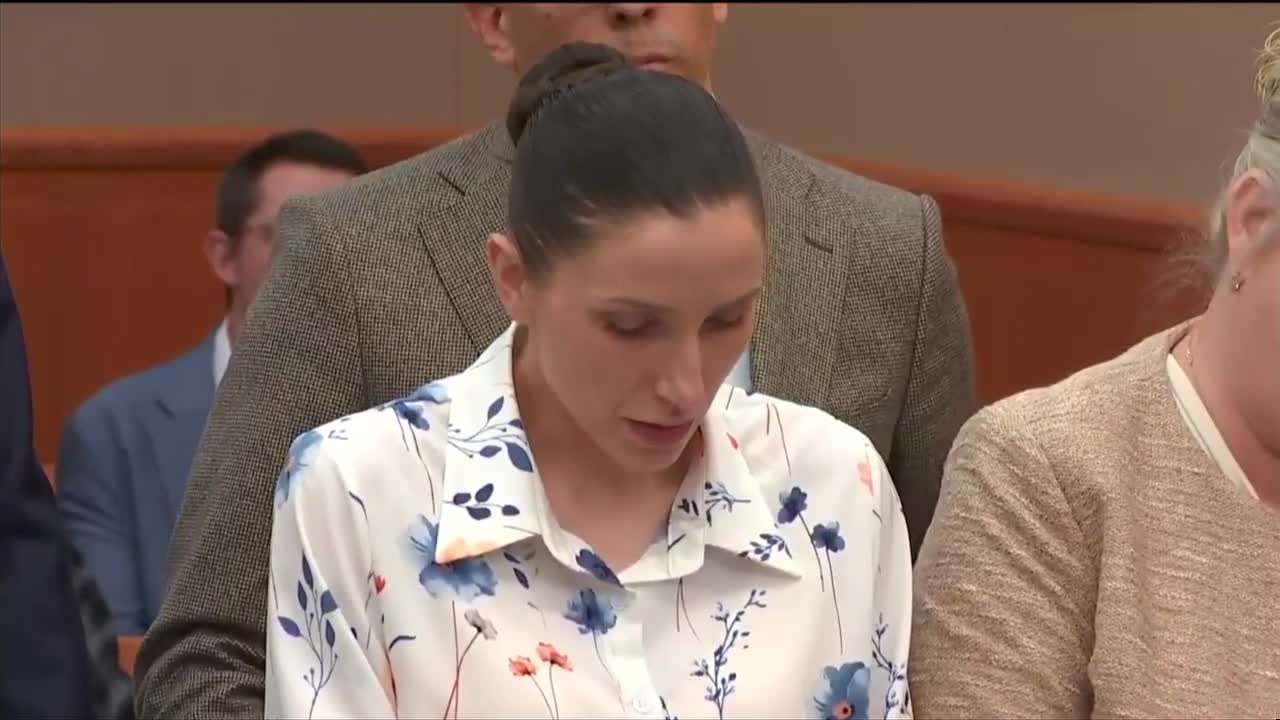

A Utah mother of three who wrote a children’s book about grief after her husband’s death was found guilty of his murder on Monday.
The jury announced that they found Kouri Richins guilty of all five counts: Aggravated murder, attempted aggravated murder, insurance fraud (two counts) and forgery. She will be sentenced on May 13.
A look of shock appeared on her face as the first "guilty" was read, and she immediately hung her head.
Richins was accused of slipping a lethal dose of fentanyl into a cocktail that she made for her husband, Eric, causing his death in March 2022 in Kamas.
The most serious charge Richins faced, aggravated murder, carries a sentence of 25 years to life in prison.
The trial was expected to take five weeks but was cut short last week when Richins waived her right to testify, and her legal team rested its case without calling any witnesses.
On Monday, the jury was read its instructions before prosecutors began their closing arguments. The arguments wrapped up on Monday afternoon, and the jury reached a verdict later in the evening.
The state once again played the 911 call after Eric Richins was found dead, with prosecutor Brian Bloodworth saying the phone call was not a wife becoming a widow, but the sound of a wife becoming a black widow.
During the call, the state left a timer up to show Richins waited six minutes before starting CPR.
Bloodworth told the jury that they got to observe Richins and see her reaction as witnesses testified during her trial. He claimed that when they first played the 911 call, Richins' behavior was flat, with no emotion. He said that when forensic accountant Brooke Karrington was on the stand, Richins was shown to be bothered because the world had allegedly seen that she was not a business success.
Immediately after the prosecution finished its closing argument, the defense called for a mistrial, arguing that the state made efforts to dehumanize Richins by calling her a black widow.
RELATED NEWS | The most anticipated trials of 2026
Attorney Wendy Lewis handled closing arguments for Richins' defense team, and said the prosecution was accusing Kouri of not grieving properly. Lewis shared how Richins was unexpectedly widowed and asked how you can judge someone in that moment. Lewis said if Richins has learned one thing from the trial, it's that she didn't grieve right.
Lewis later said the state's entire investigation was sloppy and driven by bias.
Lewis pointed to the fact that the alleged fentanyl pills were never found. The defense also argued that the expired 2016 hydrocodone bottle on the nightstand was never tested for fentanyl, even though it had residue in it. Lewis alluded to the fact that it could be a good place to bring back illicit drugs from Mexico, where Eric had gone on a trip shortly before his death.
The defense also addressed Richins' Google searches that were part of the state's case. Lewis said Richins just found out her husband died of a lethal dose of fentanyl and might want to know more. She said that even an innocent person would be worried that they are a suspect in a homicide investigation and would look up information about prisons.
At the end of the closing argument, Lewis asked the jury to be courageous if they didn't see the evidence as beyond a reasonable doubt.
"For nearly three years, the public has heard accusations about Kouri. Those accusations created a narrative that spread far beyond this courtroom. But in court, accusations are not enough. The law requires proof," the defense team said in a written statement. "After three weeks of testimony, the prosecution has failed to prove its case. The standard in this country is proof beyond a reasonable doubt. That burden has not been met. Kouri has maintained her innocence from the very beginning."
This story was originally published by Caroleina Hassett with the Scripps News Group station in Salt Lake City, Utah.
